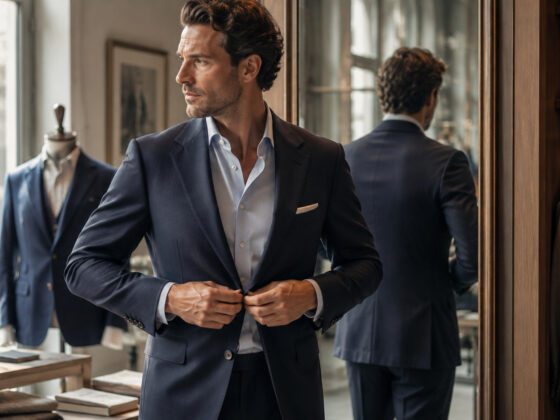


There is a profound difference between dressing well and trying to be noticed at all costs. In contemporary culture, these two ideas are often confused: style is associated with immediate impact, recognizability, and the ability to attract attention. Yet an important part of elegance has always moved in a different direction. More discreet, less noisy, but no less effective.
Dressing well without showing off means understanding that clothing should not overpower the person wearing it, but accompany them. It means building a coherent image capable of communicating presence without becoming an exhibition. It is a subtle balance, difficult to define precisely, but easy to recognize when encountered.
Because taste, more often than not, does not reveal itself through excess. It reveals itself through restraint.
The mistake of confusing elegance with visibility
For a long time, luxury was communicated through obvious symbols: visible logos, eye-catching details, objects designed to immediately express status. A logic that is understandable, especially in a society where image has gained increasing importance.
In recent years, however, something seems to have changed. Alongside the aesthetics of ostentation, another sensibility has emerged: one more interested in quality than declaration, in substance rather than immediate effect.
This does not mean that what is visible is automatically wrong. The issue lies elsewhere: when attention shifts exclusively toward the desire to be noticed, clothing risks ceasing to express personality and begins simply seeking approval.
Elegance rarely needs to raise its voice.
The strength of proportions
Very often, what makes a look truly successful is not the individual garment, but the overall harmony. Correct proportions, proper fit, and the balance of volume and color matter far more than elements designed purely to attract attention.
A jacket that drapes well, trousers with the right length, shoes appropriate to the context — these details operate almost silently. They do not seek immediate attention, but instead build a stronger and more lasting impression.
The difference is subtle but substantial. Ostentation aims for impact. Taste aims for balance.
Colors, materials, and discretion
Color choices also reveal much about one’s relationship with style. Neutral tones, natural fabrics, and measured combinations tend to age better than solutions excessively tied to temporary trends.
Blue, gray, beige, dark green, brown: not because there are inherently “more elegant” colors, but because they allow for a more harmonious wardrobe.
The same applies to materials. Wool, linen, cotton, leather, and cashmere possess a presence that does not depend on the need to stand out. Quality is often perceived more than displayed.
And it is precisely here that one of the most interesting forms of contemporary luxury emerges: the kind that feels no need to explain itself.
The risk of over-construction
There comes a point where attention to style risks becoming excessive. It happens when every element appears too calculated, too planned, too perfect.
Elegance contains an element of naturalness that is difficult to imitate. When every detail seems designed to communicate something, the result can begin to feel artificial.
For this reason, many particularly elegant men often display small imperfections: a slightly loosened tie, a less rigid fold, a detail that interrupts an overly controlled composition.
This is not disorder. It is balance.
Three signs that separate taste from ostentation
In practice, several elements help define this boundary:
- attention is focused on garment quality rather than recognizability
- the wardrobe is built around the individual rather than trends
- clothing supports presence without becoming the main character
These are not rigid rules, but useful principles
Style as a personal language
Dressing well without showing off also means letting go of the constant need to prove something. Not every choice must become a statement.
Style works best when it becomes a natural extension of the individual. When it communicates care, attention, and respect for context without turning into a continuous act of self-affirmation.
For this reason, authentic taste rarely feels constructed. It has a quieter dimension, but also a more lasting one.
When less truly becomes more
Over time, one begins to understand something important: the value of a wardrobe does not depend on the number of pieces it contains or on its ability to impress.
It depends on coherence. On the ability to choose well. On the confidence of not constantly needing to add something more.
Dressing well without showing off does not mean giving up style. It means giving style a more demanding direction: the direction of measure.
Because taste often begins exactly where excess ends.